
Georgia Duck Season 2026–2027: Dates, Bag Limits, Outlook & Where to Hunt
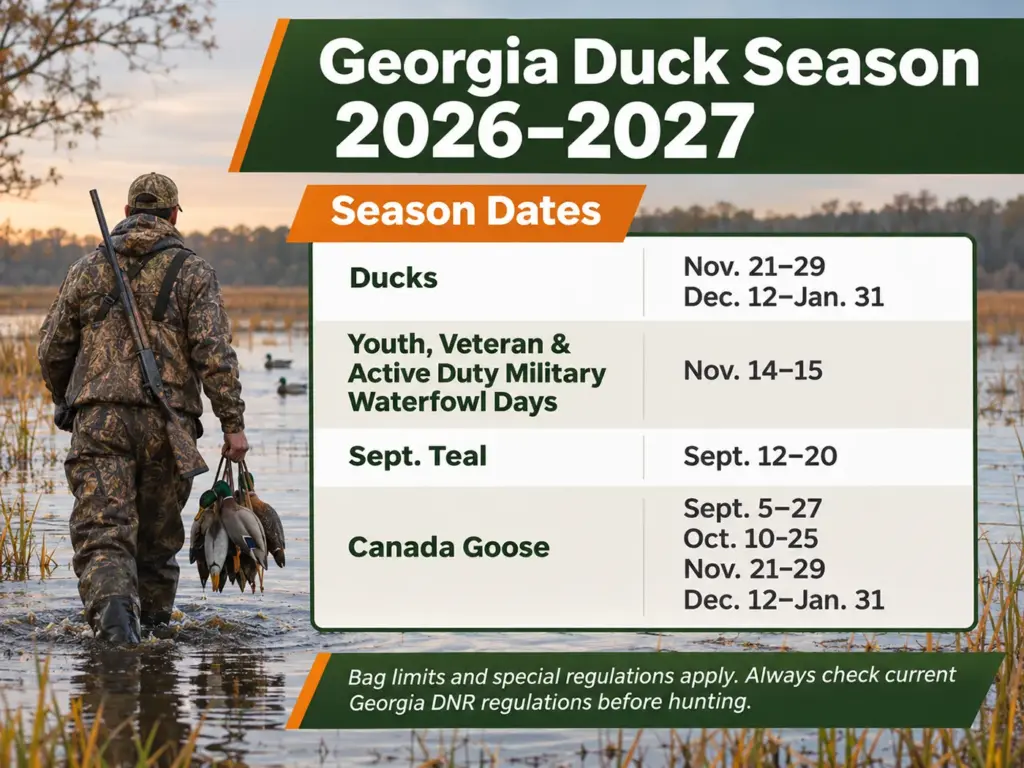
Georgia’s 2026–2027 duck hunting season opens Saturday, November 21, and runs through November 29 before reopening December 12 and continuing through January 31, 2027. Hunters can harvest up to six ducks per day, subject to species-specific limits.
The state also offers separate seasons for Canada geese, snow geese, teal and other migratory waterfowl, along with special hunting opportunities for youth, active-duty military personnel and veterans.
Whether you’re planning to hunt wood ducks in a flooded Georgia creek bottom, set decoys on a large reservoir, or take advantage of a public-land hunt, here’s what you need to know about the upcoming waterfowl season.
Georgia Waterfowl Hunting Season Dates for 2026–2027
The Georgia Department of Natural Resources (DNR) has established the following statewide waterfowl hunting seasons and daily bag limits for 2026–2027.
| Species | Season Dates | Daily Bag Limit |
|---|---|---|
| Ducks | Nov. 21–29; Dec. 12–Jan. 31 | 6 |
| Early teal | Sept. 12–20 | 6 |
| Canada geese | Sept. 5–27; Oct. 10–25; Nov. 21–29; Dec. 12–Jan. 31 | 5 |
| Snow and white-fronted geese | Oct. 10–25; Nov. 21–29; Dec. 12–Jan. 31 | 5 |
| Mergansers | Nov. 21–29; Dec. 12–Jan. 31 | 5 |
| Coots | Nov. 21–29; Dec. 12–Jan. 31 | 15 |
| Gallinules | Nov. 21–29; Dec. 12–Jan. 31 | 15 |
| Brant | Closed | — |
| Harlequin ducks | Closed | — |
All January closing dates are in 2027. Species-specific restrictions and combined bag limits apply. Possession limits are generally three times the daily bag limit.
Why Does Georgia’s Duck Season Close January 31?
Georgia’s regular duck season is divided into two segments, providing 60 days of hunting opportunity.
The first segment traditionally opens the Saturday before Thanksgiving and runs through the following Sunday, giving hunters nine days to hunt during the holiday period.
The remaining 51 days make up the second segment, which runs through January 31.
In 2018, the U.S. Fish and Wildlife Service gave states the option to extend duck hunting through January 31. Georgia has chosen to take advantage of that opportunity, reflecting hunters’ preference for a later closing date.
Because the season cannot exceed 60 days, the opening date of the second segment changes from year to year.
For 2026–2027, the second segment begins December 12 and ends January 31.
Georgia’s Youth, Military and Veterans Waterfowl Hunting Days
Georgia has designated November 14–15, 2026, as special waterfowl hunting days for youth, active-duty military personnel and veterans.
These dates provide an opportunity to hunt before the regular duck season opens.
Youth hunters must be 15 years old or younger and accompanied by an adult at least 18 years old. The accompanying adult may not hunt unless they independently qualify under the military or veteran provisions.
Eligible active-duty military personnel and veterans may also participate, provided they meet applicable licensing requirements.
Normal daily bag limits and other waterfowl hunting regulations remain in effect.
Georgia Duck Hunting Outlook for 2026–2027
Georgia duck hunters have some encouraging news heading into the 2026–2027 season, according to Georgia DNR migratory gamebird biologist Kara Nitschke.
“Being an eternal optimist, I always have expectations for a good duck season,” Nitschke told Georgia Afield. “Habitat conditions during the 2026 Waterfowl Breeding Population and Habitat Survey generally improved over a large portion of the surveyed area relative to 2025.”
Nitschke noted that above-average spring precipitation resulted in good to excellent breeding habitat across nearly all of eastern Canada and the Great Lakes region.
She also pointed to an encouraging trend closer to home: The Atlantic Flyway wood duck index has been increasing annually. That’s particularly welcome news for Georgia hunters, since wood ducks are the state’s most commonly harvested duck species.
While favorable breeding conditions don’t guarantee a successful hunting season in Georgia, they offer some reason for optimism as hunters prepare for November’s opening day.
How Weather Could Affect Duck Hunting in Georgia
Weather conditions throughout the season will play a major role in where Georgia hunters find ducks, particularly during the late December and January portion of the season.
“Pay attention to the weather – precipitation in any form will affect local feeding patterns,” Nitschke said. “Increasing wetland water levels will provide new margins for puddle ducks to feed in.”
Hunters should also keep an eye on cold fronts and freezing conditions farther north.
According to Nitschke, northern freezes can push migrating ducks south in search of open water. Monitoring those conditions ahead of time may help Georgia hunters anticipate movements into their hunting areas.
For hunters, that means scouting after significant rainfall, watching water levels in local wetlands and paying attention to freezing weather farther up the Atlantic Flyway.
Georgia Duck Hunting Bag Limits for 2026–2027
Georgia hunters may take a total of six ducks per day during the regular duck hunting season, but several species have individual limits.
Those species-specific restrictions are included within the overall six-duck limit.
| Duck Species | Daily Bag Limit |
|---|---|
| Wood duck | 3 |
| Mallard | 2, including no more than 1 hen |
| Black duck or mottled duck | 1 combined |
| Northern pintail | 1 |
| Canvasback | 2 |
| Redhead | 2 |
| Scaup | 1 |
| Fulvous whistling duck | 1 |
Sea Duck Limits
Sea ducks count toward the regular six-duck daily bag limit. No more than four of the six ducks may be sea ducks.
Individual sea duck limits include:
- Eiders: 3 per day, including no more than 1 hen
- Long-tailed ducks: 3 per day
- Scoters: 3 per day
For example, a hunter could legally harvest three wood ducks and three other ducks that are not restricted beyond the overall daily limit. However, harvesting four wood ducks would be illegal because the individual wood duck limit is three.
Hunters should become familiar with identifying different duck species before heading afield, especially when hunting areas where several species may be present.
What Licenses Do You Need to Hunt Waterfowl in Georgia?
Georgia waterfowl hunters generally need three licenses or stamps:
- Georgia Hunting License: A valid hunting license, unless the hunter qualifies for an exemption.
- Georgia Waterfowl & Migratory Bird License: Required for migratory bird hunters age 16 and older.
- Federal Duck Stamp: Required for waterfowl hunters age 16 and older, including resident landowners hunting their own property.
The Georgia Waterfowl & Migratory Bird License is available at no additional charge to holders of certain license types, including Sportsman’s and Lifetime Sportsman’s licenses. Resident landowners hunting their own property may also qualify for a free version.
Electronic Federal Duck Stamps
Hunters no longer have to carry a physical Federal Duck Stamp while hunting if they have a valid electronic stamp.
Electronic Federal Duck Stamps are valid for the applicable license year, July 1 through June 30.
Hunters can purchase the necessary licenses and stamps through Go Outdoors Georgia or participating license vendors.
Hunters planning to visit Wildlife Management Areas or other public hunting properties should also verify the applicable access requirements.
Important Georgia Waterfowl Hunting Regulations
n addition to season dates, bag limits and licensing requirements, Georgia waterfowl hunters should be familiar with several important state and federal regulations:
- Legal shooting hours: One-half hour before sunrise until sunset. Some WMAs and managed waterfowl impoundments require hunters to stop shooting at noon.
- Nontoxic shot: Only federally approved nontoxic shot may be used or possessed while hunting waterfowl.
- Shotgun capacity: Shotguns generally must be limited to three shells.
- Baiting: Hunting waterfowl over baited areas is prohibited under federal law.
These are only a few of the regulations governing waterfowl hunting. Hunters should review the complete Georgia DNR migratory bird hunting regulations before heading afield.
Where to Hunt Waterfowl on Georgia Public Land
Hunters without access to private duck hunting property can find opportunities on many of Georgia’s Wildlife Management Areas, public reservoirs and other designated hunting lands.
However, public-land waterfowl hunting regulations vary considerably.
While some WMAs allow waterfowl hunting throughout the statewide season, others restrict hunting to certain weekdays or have specific shooting hours. Managed waterfowl impoundments may require a quota permit.
Hunters looking for an overlooked public duck hunting spot in Georgia may have their work cut out for them.
“Duck hunters are an industrious bunch, and if there’s a spot on public land that’s attracting ducks, they’ve likely been found,” said Georgia DNR migratory gamebird biologist Kara Nitschke.
Still, Nitschke identified several WMAs around the state that are consistently worth exploring:
- Altamaha WMA: A coastal destination offering opportunities to harvest species beyond wood ducks and ring-necked ducks. While some areas require quota permits, other portions offer non-quota hunting opportunities.
- Conasauga River WMA: An option for public-land hunters in northern Georgia.
- West Point WMA: Worth exploring for hunters in western Georgia.
- Rum Creek WMA: A solid option for duck hunters in central Georgia.
As with any public waterfowl hunting location, hunters should consult the current WMA regulations for designated hunting days, access restrictions and quota requirements before visiting.
Some properties permit hunting on statewide season dates, while others have special limitations.
Before making a trip, consult the individual property’s listing in the 2026–2027 Georgia Hunting and Fishing Regulations.
Georgia Waterfowl Quota Hunts
Georgia DNR also offers managed waterfowl quota hunts on select properties, including Altamaha, B.F. Grant, Oconee, Rum Creek and West Point WMAs.
These hunts provide opportunities to hunt managed waterfowl habitats where participation is limited through an advance application and selection process.
The application deadline for the 2026–2027 waterfowl quota hunts was October 15, 2026, and has already passed.
Hunters interested in participating in future seasons can find information about applications and selection procedures on the Georgia DNR quota hunts page.
Special Regulations for Waterfowl Hunting on Georgia Lakes
Several Georgia reservoirs have additional restrictions designed to separate waterfowl hunting from residential structures and recreation areas.
Hunters should be familiar with these requirements before hunting from a boat or along shorelines.
Additional restrictions apply on some WMA tracts bordering these lakes. For example, Lake Seminole WMA and Lake Walter F. George WMA list 300-yard buffers around certain developed areas. Check both the lake regulations and the rules for the particular property you intend to hunt.
These restrictions are in addition to statewide waterfowl regulations. Hunters should check with the agency managing a lake for any additional rules.
Common Duck Species Found in Georgia
Georgia’s wetlands, rivers, swamps, and reservoirs provide habitat for a wide variety of ducks throughout the year. Wood ducks are among the state’s most familiar species, particularly in flooded timber, beaver ponds, and wooded creek bottoms. Blue-winged teal are some of the earliest migrants to pass through the state each fall, while green-winged teal become more common during the cooler months.
As winter approaches, hunters may encounter mallards, gadwall, American wigeon, northern shovelers, and other dabbling ducks in shallow wetlands and managed impoundments. Larger reservoirs and deeper waters attract diving ducks such as ring-necked ducks, scaup, redheads, and canvasbacks. Along Georgia’s coast, hunters may also encounter various sea ducks and other migratory waterfowl.
The species hunters encounter depends largely on location, available habitat, and migration conditions. Learning to identify ducks both on the water and in flight is especially important, since Georgia’s daily bag limits vary by species.
Georgia Waterfowl Hunting FAQs
Check the Regulations Before Heading Afield
Georgia’s 2026–2027 waterfowl season offers opportunities ranging from September teal hunts to late-January duck hunting.
Whether you’re hunting a private beaver pond, a public reservoir or a managed WMA, take time to review the regulations for your chosen location.
For official season dates, bag limits, licensing information and additional regulations, visit the Georgia DNR Migratory Bird Information page.
While Georgia Afield works to keep this information accurate and current, hunting dates and regulations can change and may vary by county or property. Always consult the current Georgia hunting regulations and any applicable property-specific rules before heading afield.