2026 Georgia Rut Dates by County (with Map)
Find the estimated peak movement period for all 159 Georgia counties, plus advice on how to use those dates to plan your hunt.
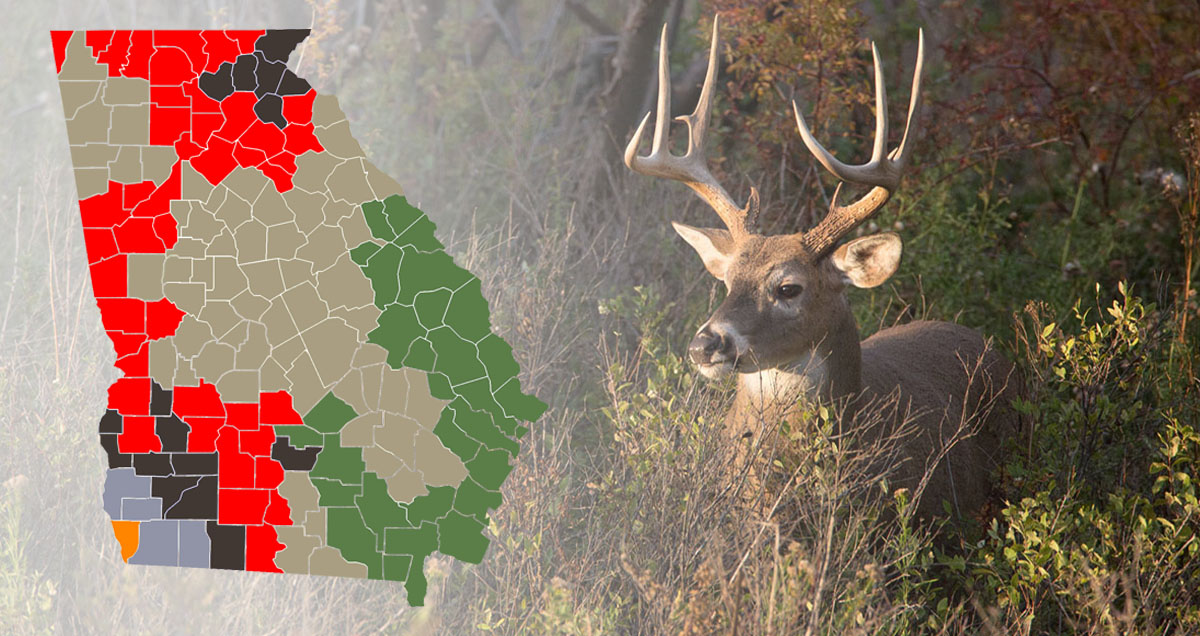
Last updated September 24, 2026
There’s nothing quite like hunting whitetails during the rut. Georgia deer hunters are fortunate in that with a little travel, we can hunt the rut from mid-October through the end of the year — that’s two and a half months of rut hunting action!
The map and county list below are based on research from the University of Georgia and Georgia’s Wildlife Resources Division. These are estimated weeks of peak deer movement, not a prediction that every doe in a county will be bred during those seven days. Start with your county, then use what you’re seeing on the ground to decide where and when to hunt.
Find the Rut Dates for Your County
Choose a county to see its estimated peak week.
These are estimated peak deer movement dates, not a guarantee of activity on a particular day. See Georgia DNR’s map and research notes.
Georgia Rut Map
Georgia DNR’s map shows how the estimated peak shifts across the state. Its dates are based on a correlation among deer-vehicle collisions, deer conception dates, and movement rates from GPS-tracked deer. Researchers used vehicle-collision data to estimate when movement peaks in each county. That makes the map a useful planning tool, but it doesn’t mean a buck will move past your stand on a particular day. View the Georgia DNR rut map and research explanation.
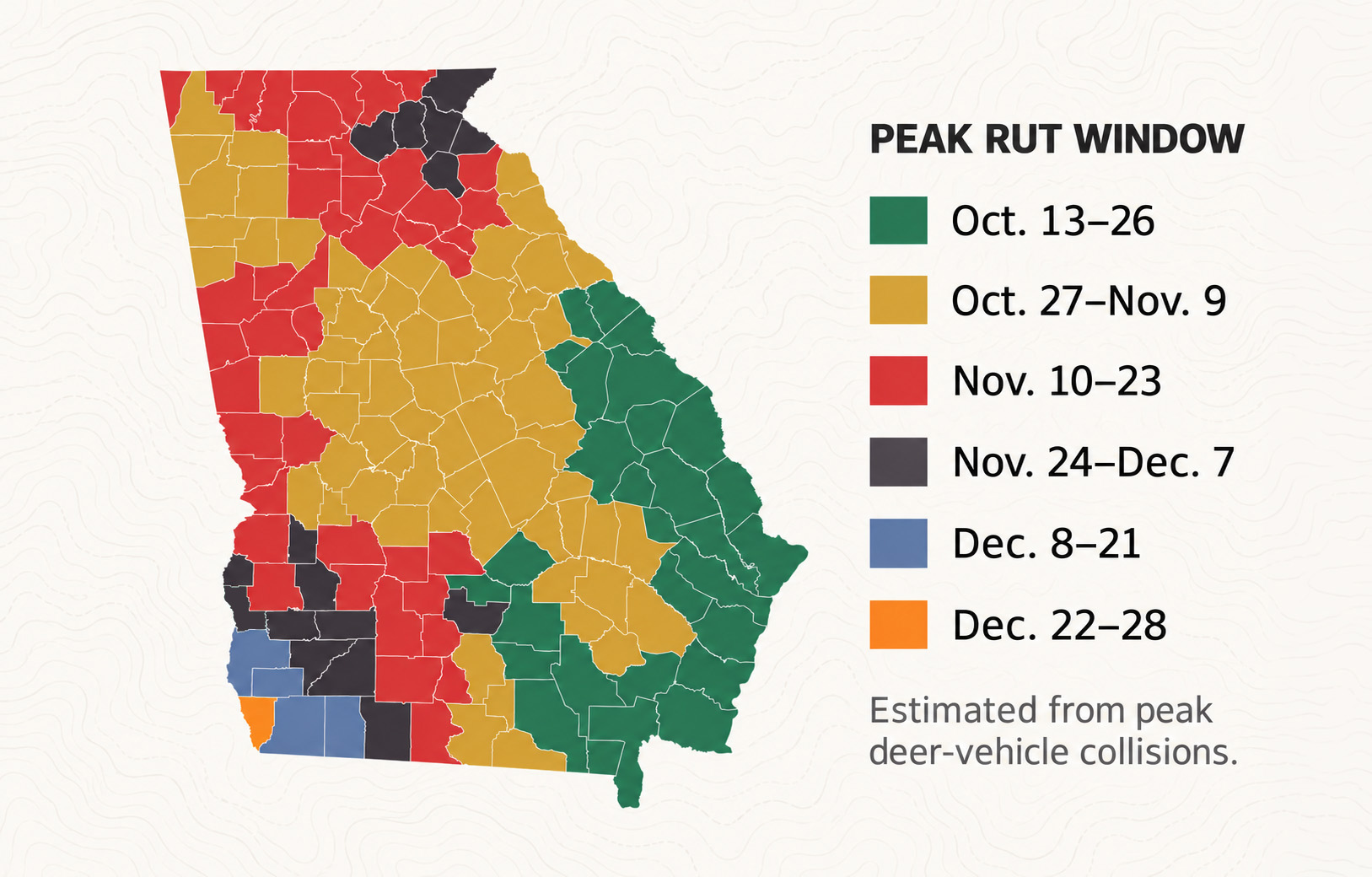
A note about confidence: Georgia DNR marks some counties on its original map with an asterisk because they had fewer than 100 deer-vehicle collisions during the study period. DNR says the dates for those counties have lower accuracy. Check the asterisks on the DNR map before treating any county estimate as precise.
Georgia Rut Dates by Week
Want to hunt the rut in more than one part of Georgia? Browse the weeks below to see which counties are approaching their estimated peak deer movement. Just click on the date bar to see what counties have peak deer movement during that week.
When Should You Hunt the Rut?
If I could only hunt a few days, I wouldn’t treat the county’s peak week like an appointment. I’d try to get in the woods before that window, hunt as much of it as I reasonably could, and keep going if I was still seeing fresh sign or bucks moving. A weeklong estimate can tell you when to prioritize your time; it can’t tell you which morning a receptive doe will draw a buck through your spot.
Pay particular attention to where does spend their time. Food availability often determines where doe groups concentrate during the fall, so understanding what deer eat in Georgia can help you narrow down the best areas to hunt. A buck searching for a receptive doe may cruise cover and travel routes between doe groups, and a funnel downwind of a bedding area can be a good place to intercept him. Scout for fresh sign and adjust to the deer you’re actually seeing rather than committing to a spot simply because it worked last year.
I also wouldn’t write off a hunt because the weather is warm or the moon phase isn’t what I hoped for. Conditions can affect when and where you see deer moving, but they don’t rewrite the county’s typical breeding season. If your cameras and sightings tell a different story from the map, trust that local information when deciding where to sit.
Why Might My Local Rut Look Different?
A county is a big area, and deer don’t read county lines. Not every doe enters estrus during the estimated peak, and local breeding activity can occur earlier or later. Sometimes a single receptive doe is enough to create a burst of chasing in your area outside the dates on the map.
The map also describes a peak in movement across a county, not the exact peak of chasing on an individual property. Treat it as one piece of evidence alongside trail-camera photos, fresh sign, and what you observe from the stand. In counties that DNR flags for limited collision data, give your own observations even more weight.
Can You Follow the Rut Across Georgia?
Potentially, yes. The DNR estimates peak movement as early as October 13–19 in several counties and as late as December 22–28 in Seminole County. That spread is one of the things that makes Georgia deer hunting interesting: if you have access in more than one part of the state, you may have multiple chances to hunt during a local peak. Check the current Georgia deer season dates, doe days and county-specific rules before making the trip.
Final Thoughts
Find your county’s estimated peak, put your best available hunting days around it, and let fresh sign and deer sightings guide the rest. A map is a great starting point. The deer in front of you are the final word.
For more help planning your season, visit our Georgia deer hunting page for season dates, public-land resources, deer processors, recovery services and the latest deer hunting news.
What county do you hunt, and when do you typically see the most chasing? Let me know in the comments—especially if your local observations differ from the map.
Sources: Georgia DNR rut map and research summary; Georgia DNR county dates and printable map.