How Georgia Brought Its Deer Herd Back, County by County
About 10 miles southwest of Thomaston, the state once turned loose 20 whitetails from Wisconsin. I live in Thomaston, so that entry in Georgia’s old deer stocking records caught my eye. The report lists the release in fiscal year 1962 and names Dick Whittington as one of the people involved.
It’s a small entry in a long table, but it tells you how different Georgia was a few generations ago. Today, I can pull up a deer harvest report and see how Upson County deer hunters are doing week to week. Back then, the state was bringing deer in from Wisconsin to help rebuild the herd.
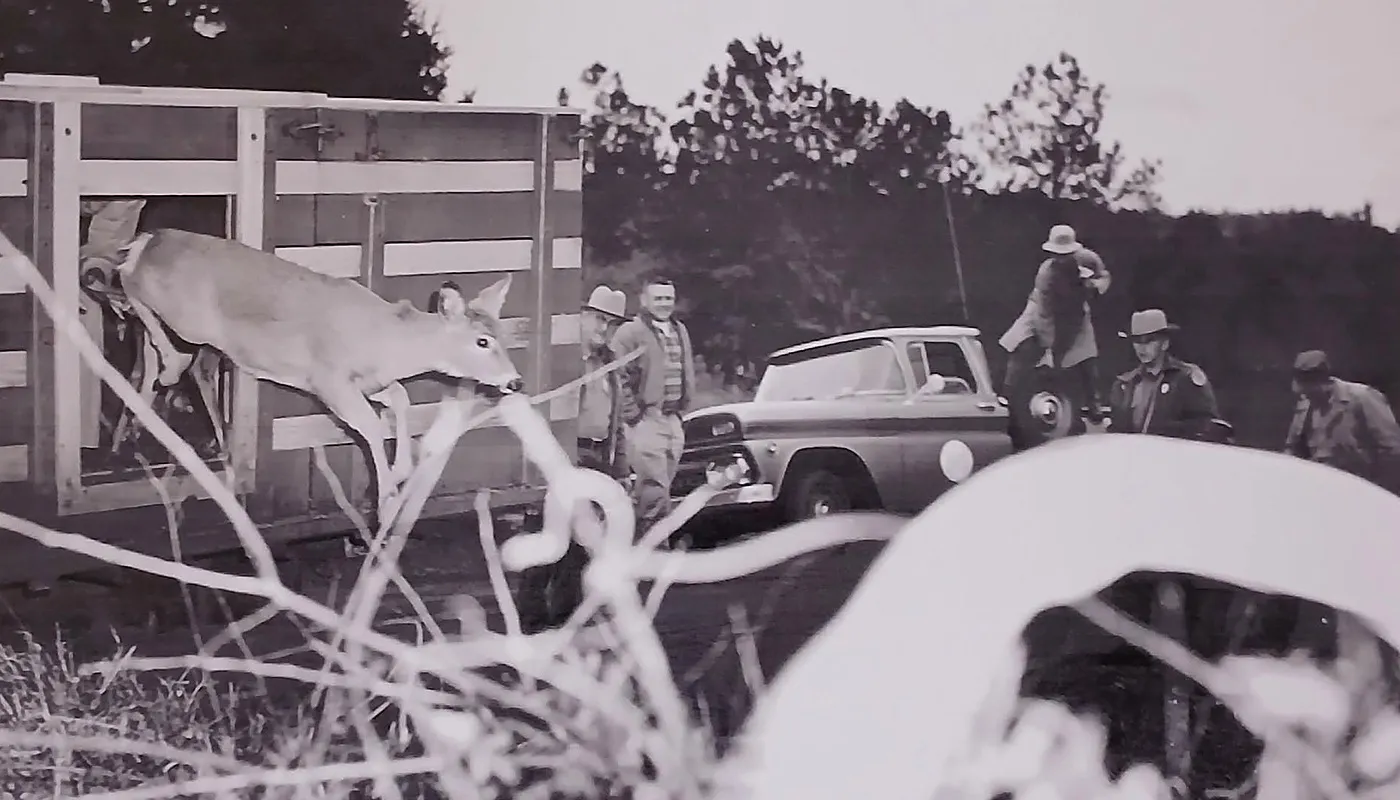
Georgia wildlife officials would eventually document more than 4,000 deer moved between 1928 and 1992. Some came from as far away as Texas and Wisconsin. More than half came from right here in Georgia. Find your county on the deer restocking map.
When deer were hard to find in Georgia
By the turn of the 20th century, whitetails had disappeared from much of Georgia’s mountains and Piedmont. Heavy hunting pressure and the loss of forest habitat had taken their toll. Deer survived in scattered pockets, including coastal islands, swamps, and river bottoms where they were harder to reach.
Some of those places would eventually provide deer for the rest of the state. Along the coast, Blackbeard and Ossabaw islands went from being places where deer had held on to places where crews could catch deer to move inland. But one of the earliest releases took place at the other end of the state, in the North Georgia mountains.
A forest ranger and four deer in the mountains
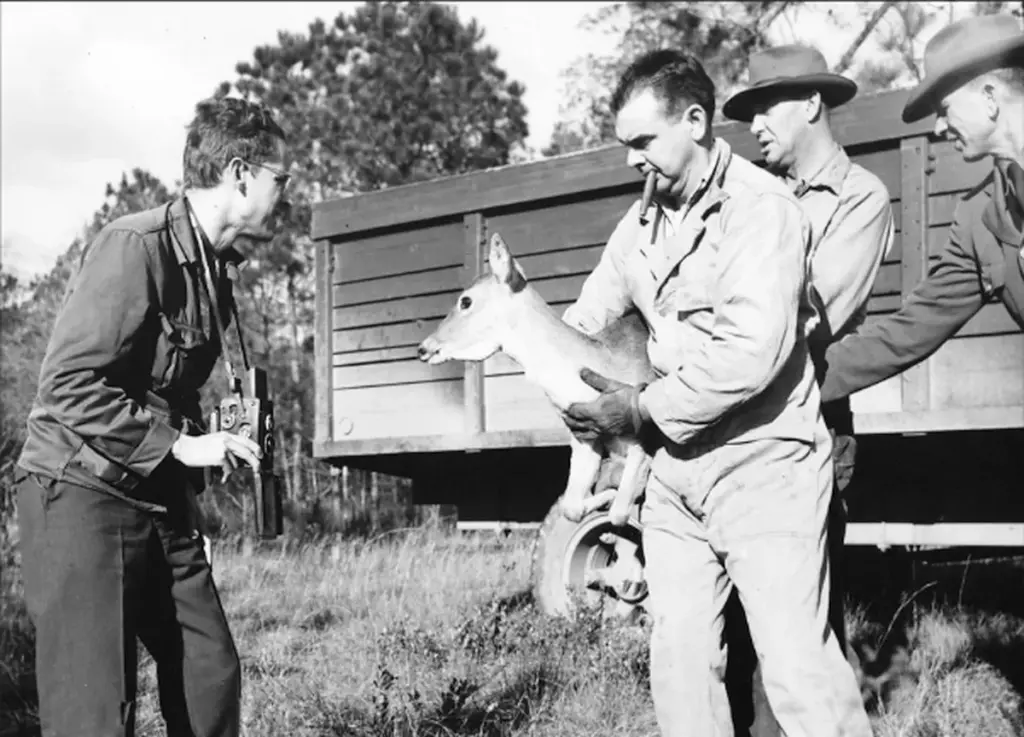
The stocking ledger lists four deer released in 1928 in what is now Blue Ridge Wildlife Management Area. They came from North Carolina’s Pisgah Game Preserve, and the man behind the effort was U.S. Forest Service ranger Arthur Woody.
The ledger gives the count. Georgia’s 1975 history of the program gives you a better idea of the man. It describes Woody taking his family to North Carolina in a Dodge to get fawns. He gave them names, including Nimble and Bunny Girl. The same history recounts how he took in deer left behind by a carnival in Cleveland, Georgia. The deer went into a fenced enclosure at Hightower Gap before being released.
More stocking followed, and in 1940 Blue Ridge held its first managed deer hunt. Twelve years after that first recorded release, people were hunting deer on the same land where Woody had worked to bring them back.
If you’d like to hunt a WMA yourself, here’s my guide to getting started with public-land deer hunting in Georgia.
Georgia started moving deer on a much bigger scale
The state’s ledger lists a 1944 entry for 143 deer at Cedar Creek WMA in Jasper, Jones, and Putnam counties. Of those, 90 came from Wisconsin, 32 from Kentucky, and 21 from Georgia’s Blackbeard Island.
By April 1962, the Game and Fish Commission was reporting that it had released 800 deer in 50 counties and four state management areas. The deer came from Wisconsin and Texas. Commission Director Fulton Lovell said the agency held off announcing the work until it was finished because it had faced pressure to put deer in places biologists considered unsuitable. The commission also announced that counties in the program would be closed to deer hunting for at least five years to give the animals time to establish.
The same fiscal year as the Upson County release, the ledger records another 22 Wisconsin deer going out about four miles north of Reynolds in Taylor County.
Where Georgia Restocked Deer
Explore documented whitetail releases from 1928 to 1992. Tap a county or search by name.
Upson County
1 documented entry
-
Fiscal year 1962
20 whitetails · Wisconsin
About 10 miles southwest of Thomaston.
The ledger lists Dick Whittington among the people involved.
Stocking ledger · PDF page 41
Sources and how to read the map
A gray county has no release entry in the records reviewed. The historic records contain gaps. Map boundaries are present-day.
Counts labeled as shared apply to the entire release. Appendix entries for later years often group several counties and give no county-level counts or locations. Those entries appear under each county named for that year.
The map uses Table I through 1974 and the WRD centennial appendix for 1975–1992. Table I uses fiscal years unless it marks a calendar year. Fiscal year 1962 ran from July 1, 1961, through June 30, 1962. Approximate counts and uncertainties are identified in the entries.
Records: Georgia’s 1975 stocking ledger, Table I and Georgia WRD’s centennial history, Appendix 2. County boundaries: U.S. Census Bureau, 2024 cartographic boundaries.
Most of the deer came from Georgia
Of the 4,067 deer in DNR’s later tally, 2,204 came from within the state. The other 1,863 came from outside Georgia or had an unknown origin. Along with the coastal islands, the ledgers list places such as Piedmont National Wildlife Refuge and Berry College as sources.
There was a practical reason to buy deer out of state. The 1975 report says crews could spend a month or more trapping a small number of deer in Georgia. In the early 1960s, they could buy deer for about $35 a head. Some hunters figured the state wanted Wisconsin deer to grow bigger bucks. Jack Crockford, who went on to lead the Game and Fish Division, said Wisconsin was a dependable place to get deer.
Catching them in Georgia took some ingenuity. On the coastal islands, deer had plenty to eat, and baited box traps could turn up a hog, a raccoon, or even a cow. Crockford worked with researchers at the University of Georgia to develop what became the Cap-Chur dart gun. Restocking helped drive an invention that made it easier for wildlife crews to handle live animals.
Giving the herd a chance to come back
One of the more telling entries in the state’s history comes from northwest Georgia. At Cohutta WMA, the commission had stocked deer and assigned a manager to protect them. The herd still struggled. The state’s account describes year-round hunting and free-roaming dogs and says the commission pulled out in 1960. Local residents later asked for the management area back, and the state reestablished it in 1968.
Across Georgia, old fields growing back into woods gave deer more habitat. Seasons and enforcement gave breeding herds a chance to grow. The federal Pittman-Robertson program helped pay for the work, and local cooperation made a difference once those deer were on the ground.
Most of the stocking was over by the mid-1960s, though DNR’s records show smaller transfers continuing through 1992. Those records give us a way to look back at how the work unfolded near home. If you look up your county, you might find an old farm name, a creek you’ve crossed a hundred times, or a spot listed simply as ten miles southwest of town.
Sources
- The History of the Georgia Deer Stocking Program, Georgia Game and Fish Division, 1975. Table I lists individual releases and explains the fiscal-year dates.
- Georgia Wildlife Resources Division Centennial, 1911–2011. Appendix 2 summarizes documented stocking from 1928 through 1992.
- Georgia Outdoors, April 1962. The original Game and Fish Commission account of the 800-deer stocking effort.
- Understanding Deer, Bear, and Forest Trends in the North Georgia Mountains. The research paper dates Blue Ridge’s first managed hunt and puts the early restoration in context.