Flathead Catfish Fishing in Georgia: Best Places, Baits and Techniques
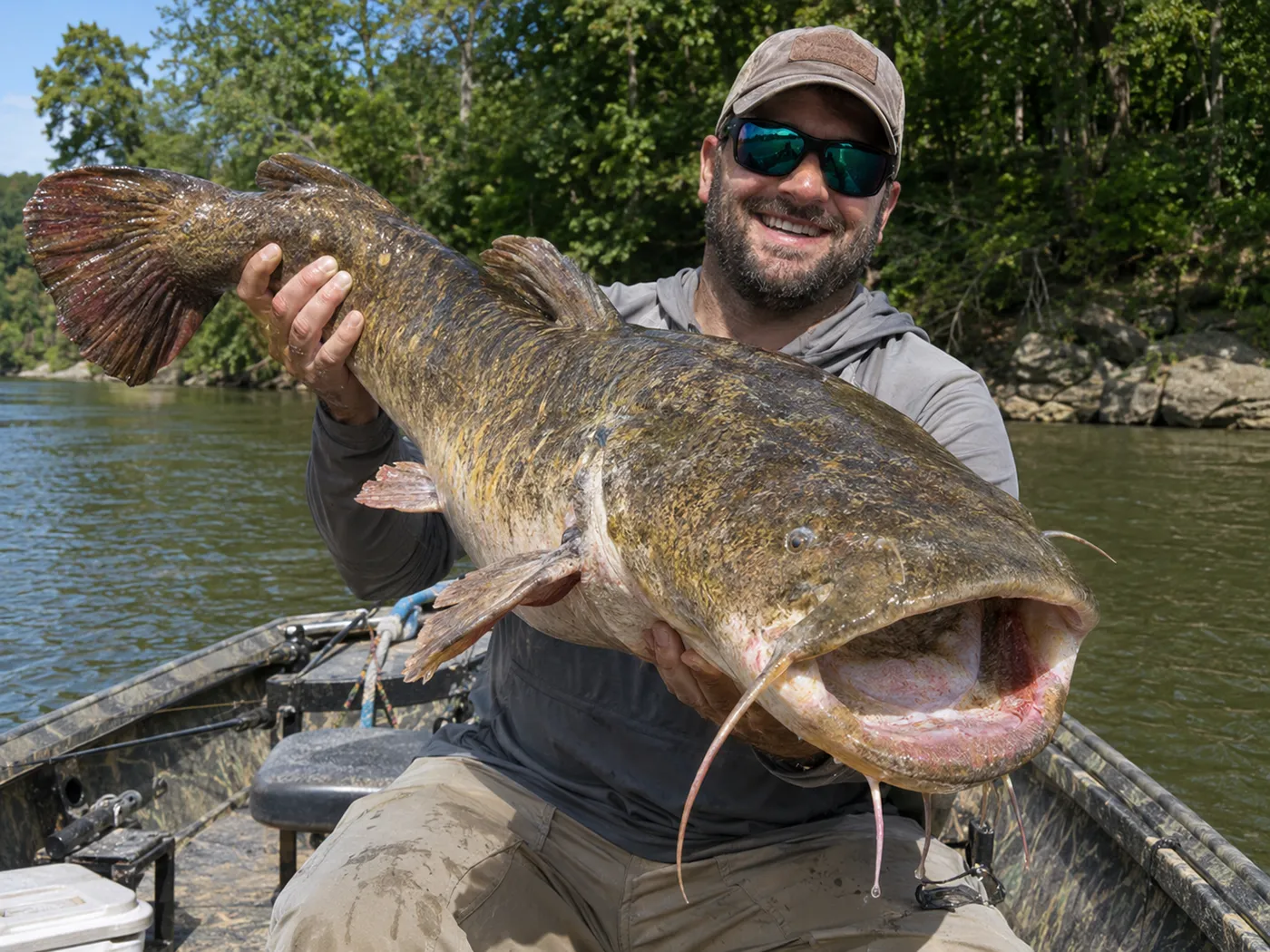
Georgia is home to some outstanding flathead catfish fishing, with opportunities to catch these powerful predators in several rivers and reservoirs across the state. For anglers looking for a trophy fish, the Altamaha River is a particularly good place to start. After all, both Georgia state-record flatheads came from the Altamaha, each weighing an impressive 83 pounds.
Other promising destinations include the Flint and Ocmulgee rivers, along with reservoirs such as Lake Andrews and Lake Chehaw.
The key to catching flathead catfish is fishing the right locations with the right bait. Unlike channel catfish, which readily take a wide variety of baits, adult flatheads feed primarily on other fish. Live baitfish presented near submerged timber, deep holes, and other underwater cover are among the most effective ways to catch them.
Whether you’re after your first flathead or hoping to catch a 40-pounder, here’s what you need to know about finding and catching them in Georgia.
Interested in other catfish species? Check out our Georgia Catfish Fishing Guide for more information on catching channel catfish, blue catfish, and other species found throughout the state.
Georgia Flathead Fishing at a Glance
Best Places to Catch Flathead Catfish in Georgia
Flathead catfish (Pylodictis olivaris) occur in several Georgia river systems, including the Altamaha, Flint, Ocmulgee, Oconee, Savannah, and Coosa river basins.
Some of these waters have established recreational fisheries, while others contain introduced populations that have raised conservation concerns.
For anglers specifically targeting flatheads, the following destinations are worth considering.
| Location | Why Fish Here? |
|---|---|
| Altamaha River | Proven trophy water that produced both 83-pound state records |
| Flint River | Established flathead fishery with deep holes and woody cover |
| Ocmulgee River | River fishing opportunities, particularly along the upper river |
| Lake Andrews | DNR-listed destination for flathead, blue, and channel catfish |
| Lake Chehaw | DNR-listed flathead fishery near Albany |
| Clarks Hill Lake | Large Savannah River reservoir with multiple catfish species |
| Lake Blackshear | Flint River reservoir with flathead opportunities, though channel catfish receive more emphasis in DNR forecasts |
Altamaha River
The Altamaha River is one of Georgia’s best-known flathead catfish fisheries, and its reputation for producing big fish is well deserved.
The river begins at the confluence of the Ocmulgee and Oconee rivers near Lumber City and flows eastward toward the Georgia coast. Along the way, anglers encounter deep channels, sweeping bends, submerged timber, and other excellent catfish habitat.
The Altamaha also holds both of Georgia’s 83-pound state-record flatheads, caught in 2006 and 2010.
Where to concentrate your efforts:
- Deep outside bends where current has scoured holes along the riverbank.
- Large logjams and submerged trees near deeper water.
- The upstream and downstream ends of deep river holes.
- Current breaks where flatheads can hold near passing baitfish.
- Shallow flats and sandbars adjacent to deep water after sunset.
The river’s lower reaches around Jesup are worth exploring, but productive habitat occurs throughout the river.
One challenge on the Altamaha is changing water levels. A productive hole during normal flow may be difficult to fish when the river rises, while low water can expose sandbars and submerged obstacles.
Fishing tip: Rather than anchoring in the middle of a deep hole, try positioning your boat so you can present bait along the edge of submerged timber or other cover. This can put your bait in a flathead’s likely feeding area without dropping it directly into a snag.
Flint River
The Flint River is another excellent destination for anglers pursuing Georgia flatheads.
Running from the Atlanta area through southwest Georgia, the Flint offers a variety of fishing conditions, from rocky sections with noticeable current to deeper, slower-moving pools.
Georgia DNR identifies flathead catfish among the fishing opportunities in both the upper and lower Flint River.
The lower river, particularly around Albany and downstream toward Lake Seminole, provides plenty of habitat for large catfish.
Look for deep outside bends, submerged trees, rocky areas, and changes in current.
A good starting approach is to locate a deep hole during daylight, identify nearby cover, and return to fish the edges around dusk.
Ocmulgee River
The Ocmulgee River offers another opportunity to catch flathead catfish in central and south Georgia.
Georgia DNR specifically identifies flatheads among the species available in the upper Ocmulgee. The lower river also supports catfish fishing, although flatheads are not singled out in DNR’s current summary of its best fishing opportunities.
Anglers should focus on the same types of habitat that make the Altamaha productive: deep river bends, submerged timber, current seams, and holes with nearby shallow feeding areas.
The Ocmulgee also has sections where shoals and changing river levels can create challenging boating conditions.
Fishing tip: On smaller or more confined stretches of river, don’t overlook deep holes immediately downstream of shoals or other changes in current. These areas can collect baitfish and provide places for flatheads to ambush prey.
Lake Andrews (Walter F. George Lock and Dam to George W. Andrews Lock and Dam)
Lake Andrews is an overlooked destination for anglers interested in Georgia flathead catfish.
Located on the Chattahoochee River along the Georgia-Alabama border, this riverine reservoir offers opportunities for flathead, blue, and channel catfish. All three are specifically identified in Georgia DNR’s fishing forecasts.
Anglers can concentrate on the old river channel, deeper bends, submerged cover, and places where current creates feeding opportunities.
Because this is a river-system reservoir, water movement can be particularly important. Changes in dam operations can affect current, water levels, and fishing conditions.
Check applicable border-water regulations before fishing.
Lake Chehaw
Located near Albany, Lake Chehaw is another Georgia reservoir worth considering for flathead catfish.
The lake sits near the confluence of the Flint and Kinchafoonee Creek systems and is specifically listed by Georgia DNR as a destination for flathead and channel catfish.
The combination of river channels, woody cover, and deeper water provides habitat for catfish.
Start by investigating channel edges, submerged trees, and deeper water near creek and river channels.
Lake Chehaw is a particularly useful option for southwest Georgia anglers looking for alternatives to the larger stretches of the Flint River.
Clarks Hill Lake and Lake Blackshear
Both reservoirs offer additional catfishing opportunities, although they wouldn’t be my first recommendations over the Altamaha, Flint, or fisheries specifically highlighted for flatheads in DNR forecasts.
Clarks Hill Lake, also known as J. Strom Thurmond Lake, is a large Savannah River reservoir with extensive channel habitat, rocky points, and submerged cover. Flatheads have been caught here, including notably large fish.
Lake Blackshear, located on the Flint River, also provides flathead opportunities. Its river channel, deeper holes, and submerged timber are sensible places to begin searching.
Georgia DNR’s current forecasts emphasize catfish generally at Clarks Hill and channel catfish at Blackshear, rather than identifying either reservoir as a leading flathead destination.
Anglers who already know these lakes may find it worthwhile to target flatheads, but those planning a dedicated trophy trip have stronger evidence-based starting points elsewhere.
For the most current fishing information, access points, and downloadable maps, visit Georgia DNR’s Fishing Forecasts.
Georgia Flathead Catfish Access Map
Explore Georgia WRD water-access locations associated with flathead catfish. Filter by waterbody or access type, then tap a marker for details and directions.
About this map: Access locations and flathead associations come from a Georgia Wildlife Resources Division GeoJSON dataset supplied to Georgia Afield. A flathead designation means the species is associated with the waterbody, not that fish are necessarily present or biting at a particular ramp. Status, fees, public availability and facilities may have changed; verify before traveling. “Unknown” does not mean open. Some listed sites may have private operators or restricted access.
Map tiles © OpenStreetMap contributors · Map functionality: Leaflet · Source: Georgia WRD water-access dataset (date of last update not supplied).
What Is the Best Bait for Flathead Catfish?
Live fish are generally the best bait for targeting large flathead catfish. Unlike channel catfish, which commonly feed on worms, insects, dead fish, and other foods, mature flatheads are primarily fish predators.
They frequently feed on sunfish, shad, minnows, and other fish available in their habitat.
Some of the most useful bait options include:
| Bait | Best Use |
|---|---|
| Live bluegill or other legal sunfish | Excellent for targeting larger flatheads around cover |
| Live shad | Natural bait option where shad are abundant |
| Live minnows or other legal baitfish | Useful for smaller and medium-sized flatheads |
| Freshly killed fish | An alternative when live bait isn’t producing |
| Fresh cut bait | Worth trying when live bait is unavailable or fish are feeding opportunistically |
Live Bluegill and Sunfish
Live bluegill and other sunfish are popular with flathead anglers because they are hardy and represent a natural food source.
Choose a baitfish size appropriate for the flatheads you’re targeting and the hooks you’re using. A medium-sized sunfish can be an effective bait without requiring an unusually large hook.
When fishing around heavy cover, hook the baitfish carefully so it remains lively and can swim naturally.
Hooking through the upper back behind the dorsal fin, while avoiding the spine, is one common method. Hooking through the lips can work well when presenting bait in current.
Important: Georgia permits legally caught game fish to be used as live bait where live bait is allowed, provided all applicable regulations and creel limits are followed. Never assume a baitfish can be legally transported or released into another body of water.
Fresh Bait Can Catch Flatheads, Too
There’s a common belief that flathead catfish only eat live bait.
That isn’t true.
Although large flatheads strongly favor fish prey, they will also eat freshly killed fish and sometimes cut bait.
Georgia DNR specifically recommends live or freshly killed fish when targeting large flatheads.
Live bait is an excellent starting point, but if you’re struggling to find baitfish or fish aren’t responding, trying fresh bait is reasonable.
Stink bait, chicken liver, and worms are generally better choices for channel catfish than for anglers specifically targeting trophy flatheads.
Where Do Flathead Catfish Hide?
Finding the right water is only the beginning. The next challenge is locating the specific areas flatheads use for shelter and feeding.
Flathead catfish are ambush predators. They often spend daylight hours near cover and deeper water, moving into nearby feeding areas when conditions are favorable.
Deep River Holes
Deep holes are among the first places to look, particularly in rivers such as the Altamaha and Flint.
These holes frequently form along outside bends, where current scours the bottom and creates deeper water.
The best holes often contain additional features such as submerged logs, rock, or changes in current.
Rather than fishing only the deepest part of the hole, experiment with its upstream edge, downstream edge, and nearby cover.
Submerged Trees and Logjams
Flatheads are closely associated with woody cover.
Large submerged trees, root balls, and logjams create shelter and ambush opportunities.
The most promising timber often has deeper water and current nearby.
Heavy cover can also cost anglers plenty of tackle, so use strong line and position your bait where you have a reasonable chance of bringing a hooked fish into open water.
Current Breaks
Flatheads frequently use areas where they can remain relatively sheltered while food moves past them.
Look for current seams around fallen trees, downstream of large rocks, near channel bends, and alongside other obstructions.
These areas are especially attractive when current is strong enough to concentrate baitfish.
Shallow Feeding Areas
Don’t assume flatheads always remain in deep water.
After dark, large fish may move onto adjacent flats, sandbars, and shallower areas to feed.
A shallow feeding area located near a deep hole or submerged timber can be particularly productive.
A good rule of thumb: Find deep water, locate nearby cover, and then identify the easiest route for a flathead to reach shallower feeding areas. Those transitions are often excellent places to set up.
Best Time to Catch Flathead Catfish in Georgia
Flatheads can be caught throughout the year, but the warmer months generally provide the most consistent fishing.
Best Months
Late spring through summer is a particularly good period to target flatheads in Georgia.
As water temperatures warm, flatheads become more active and feeding opportunities improve. Activity can also be strong in early fall while water temperatures remain favorable.
The following seasonal patterns provide a general starting point.
| Season | What to Expect |
|---|---|
| Spring | Activity increases as the water warms; focus on cover and deeper holes |
| Summer | Consistent warm-water opportunity, particularly during evening and nighttime |
| Fall | Good fishing can continue while water temperatures remain relatively warm |
| Winter | Slower feeding and more challenging fishing; concentrate on deeper holding areas |
Water levels, current, temperature changes, and local conditions can all influence feeding patterns. Calendar dates alone won’t tell you when fish will be most active.
Is Night Fishing Better for Flatheads?
Night fishing is one of the most popular and productive approaches, especially during summer.
Flatheads often become more active around dusk and can move from deep holding areas into shallower water to hunt.
However, they aren’t strictly nocturnal. Daytime catches are common, particularly when anglers present bait close to cover.
If you’re planning your first dedicated flathead trip, the final couple of hours before sunset and the first several hours after dark are a good window to try.
Do Flatheads Bite During the Day?
Absolutely.
Daytime fishing can be effective, particularly around deep timber, undercut banks, and other sheltered locations.
The biggest difference is that you may need to place your bait closer to the fish’s holding area rather than waiting for it to move into open water.
Best Rods, Reels and Tackle for Flathead Catfish
Flathead catfish are powerful fish, and many of Georgia’s best fishing locations contain enough submerged timber to make landing a large one a challenge.
You don’t need expensive equipment, but tackle designed for small channel catfish may not be sufficient for big flatheads.
Here’s a practical setup for Georgia’s larger rivers and reservoirs.
| Equipment | Recommendation |
|---|---|
| Rod | 7–8-foot medium-heavy or heavy catfish rod |
| Reel | Heavy-duty baitcasting reel or large spinning reel |
| Main line | 30–50 lb monofilament or braided line; heavier near substantial cover |
| Leader | 40–80 lb abrasion-resistant monofilament, adjusted to conditions |
| Hooks | 5/0–8/0 heavy-duty circle hooks for many live-bait applications |
| Sinkers | Approximately 1–5 oz, depending on current and bait size |
| Accessories | Strong swivels, rod holders, landing net, pliers, and headlamp |
These are practical starting ranges rather than rigid requirements. A large baitfish in strong current may require heavier tackle than a small baitfish in a quiet lake cove.
Best Flathead Catfish Rig
A sliding sinker rig, often called a Carolina or slip-sinker rig, is an excellent all-around choice.
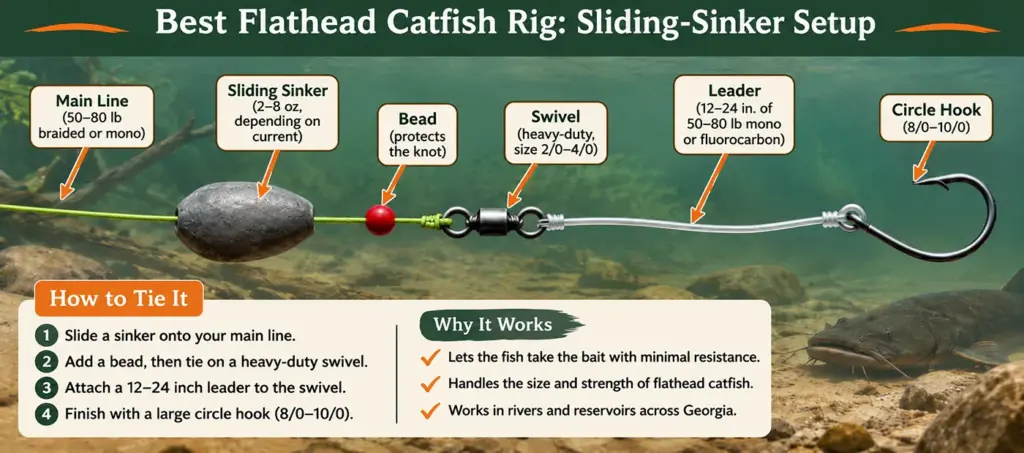
The sliding sinker allows the baitfish some movement while keeping the presentation near the bottom.
A no-roll sinker is particularly useful in current because it is less likely to tumble along the riverbed.
If you’re using a circle hook, avoid a hard, sweeping hookset. Maintain steady pressure and allow the rod to load as the fish takes the bait.
Should You Use a Three-Way Rig?
A three-way rig is another useful option, especially when fishing current or areas where you want to position your bait slightly above the bottom.
It allows you to attach a sinker to a separate dropper line and your bait to a leader.
This arrangement can help keep the bait in a productive position and may reduce some snags, although no rig is completely snag-proof around heavy timber.
How to Catch Flatheads From a Boat or the Bank
You don’t need a large fishing boat to catch flatheads in Georgia. Some productive holes and feeding areas are accessible from shore, although a boat makes it easier to explore and fish cover.
Fishing From a Boat
A boat allows you to use sonar to identify deep holes, submerged timber, and changes in bottom contour.
Start by locating a promising section of river and identifying several potential holding areas.
Anchor or position the boat so your bait can be presented near cover without placing the boat directly over the area you intend to fish.
If a location isn’t producing, try moving to another hole, logjam, or current break.
Fishing From the Bank
Bank fishing can be productive when you have access to deep water or nearby fish-holding cover.
Look for:
- Public access areas with deep water close to shore.
- River bends where the channel runs near the bank.
- Legal shoreline access near bridges and riprap.
- Accessible stretches with submerged timber or current breaks.
- Shallow flats connected to deeper water for evening fishing.
A longer, heavy-duty rod can help with casting and controlling fish from the bank.
Secure your rod in a sturdy holder, particularly when using live bait. A large flathead is capable of pulling an unsecured rod into the water.
Never assume a boat ramp, bridge, or adjoining property provides unrestricted bank access.
A Simple Plan for Your First Flathead Trip
If you’re new to flathead fishing, keep the approach straightforward.
Find a river with an established flathead population and select a stretch containing deep holes and submerged timber.
Arrive before sunset to scout the area and get your equipment organized.
Fish a legal live baitfish near deep cover and another along the edge of the hole, where fish may move to feed.
Give promising locations time to produce, but don’t spend the entire evening in one spot if nothing is happening.
Above all, be prepared for the possibility that the first bite may come from a much larger fish than you’re accustomed to catching.
Georgia Flathead Catfish Fishing Regulations (2026–2027)
Georgia’s current freshwater fishing regulations provide relatively liberal opportunities for flathead catfish.
Here’s a summary of the principal statewide recreational rules for the 2026–27 regulation year.
| Regulation | Georgia Rule |
|---|---|
| Fishing license | Required for most anglers age 16 and older |
| Daily creel limit | No statewide limit on flathead catfish |
| Minimum size limit | No statewide minimum |
| Hook-and-line season | Open year-round in waters without applicable closures |
| Live game fish as bait | Permitted where legal, if baitfish are lawfully taken and applicable limits are followed |
| Noodling season | March 1–July 15 |
| Trotlines, set hooks and jugs | Permitted under applicable method-specific restrictions |
Georgia also allows catfish to be taken by bow and arrow under its current bowfishing rules, which include provisions for nighttime fishing.
Important exceptions: Certain waters have additional restrictions, and fishing methods such as trotlines and jugs are prohibited in some locations, including Public Fishing Areas and State Park lakes.
Georgia’s 2026–27 regulations also specify requirements for marking and tending sport trotlines.
Some Georgia waters bordering South Carolina or Alabama are subject to special agreements or rules. Always confirm the regulations applicable to the specific water and fishing method before your trip.
For complete details, consult Georgia DNR’s current fishing regulations.
Georgia’s State-Record Flathead Catfish
Georgia’s official state record for flathead catfish is 83 pounds, shared by two anglers who caught their fish from the Altamaha River.
| Angler | Weight | Water | Date |
|---|---|---|---|
| Carl Sawyer | 83 pounds | Altamaha River | June 22, 2006 |
| Jim Dieveney | 83 pounds | Altamaha River | July 11, 2010 |
The two catches demonstrate the trophy potential of Georgia’s river systems, particularly the Altamaha.
Flathead catfish can grow to exceptionally large sizes, although most fish encountered by anglers are considerably smaller than the state record.
Anglers who believe they’ve caught a potential state record should follow Georgia DNR’s procedures for documenting, weighing, and verifying the fish.
See the official Georgia freshwater fishing records for the latest information.
How to Identify a Flathead Catfish
Flathead catfish are relatively easy to distinguish from Georgia’s other large catfish once you know what to look for.
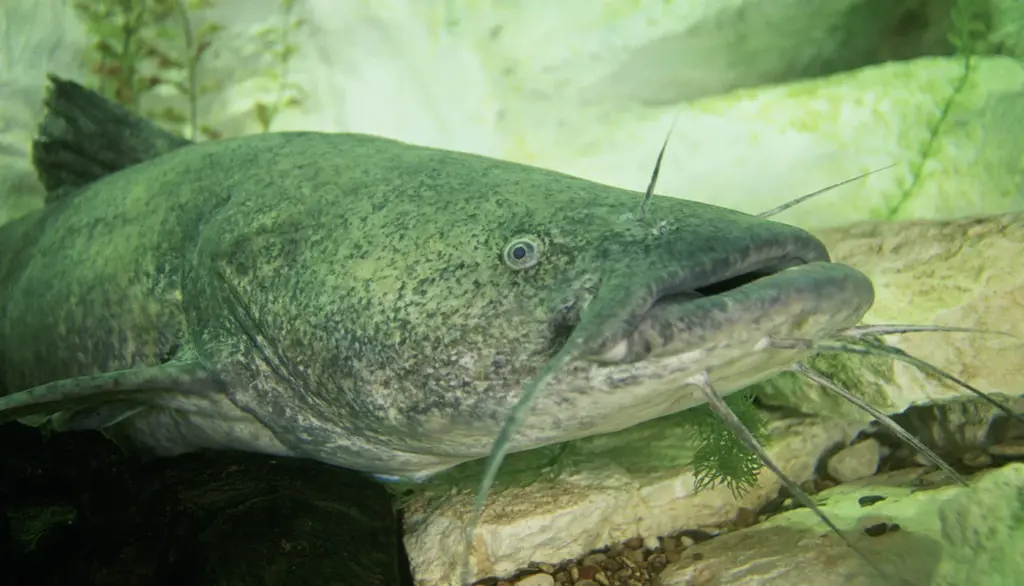
Their most noticeable characteristic is a broad, flattened head with a large mouth.
Other identifying features include:
- Yellowish-brown, olive, or mottled body coloration.
- A lower jaw that extends beyond the upper jaw.
- Small eyes.
- A tail that is not deeply forked.
- A broad, muscular body, particularly in larger specimens.
Blue and channel catfish have distinctly forked tails, making tail shape one of the easiest ways to distinguish them from flatheads.
Flatheads may also be called yellow catfish or shovelhead catfish in some areas.
Are Flathead Catfish Native to Georgia?
Flathead catfish are native to portions of Georgia’s western river drainages, including the Coosa River system, but they are not native to every Georgia river where they’re now found.
Introduced populations have become established in several Atlantic-slope watersheds.
That distinction matters because flatheads are highly effective predators of other fish.
The Satilla River Flathead Problem
The Satilla River in southeast Georgia provides one of the state’s clearest examples of the ecological impacts introduced flatheads can have.
The Satilla has long been known for its redbreast sunfish fishery, attracting generations of anglers to its blackwater streams.
However, flathead catfish were introduced into the river during the 1990s.
As the population expanded, fisheries biologists documented substantial concerns about predation on native redbreast sunfish, bullheads, and other species.
Georgia DNR subsequently established a flathead catfish removal program to reduce their numbers and protect native fish populations.
The program demonstrates that while flatheads can provide outstanding recreational fishing opportunities, introducing them into waters where they don’t belong can have serious consequences.
Anglers should never transport and release flathead catfish, or any other fish, into a different river, lake, or stream without proper authorization.
Learn more about the Satilla River Flathead Catfish Removal Project.
Frequently Asked Questions About Georgia Flathead Catfish
Before You Go
Flathead catfish fishing doesn’t have to be complicated. Find a Georgia river or reservoir with an established population, locate deep water and submerged cover, and present a lively baitfish near the areas where flatheads are likely to be holding or feeding.
If you’re planning your first dedicated flathead trip, the Altamaha or Flint River would be good places to begin.
Before leaving home, check the latest Georgia DNR fishing forecasts, river levels, boat access conditions, and applicable regulations. River conditions can change rapidly, and submerged timber, shoals, and shifting sandbars deserve particular attention when boating after dark.
While Georgia Afield works to keep this information accurate and current, fishing regulations and access conditions can change and may vary by waterbody. Always consult the current Georgia fishing regulations and applicable location-specific rules before heading out.