
Here’s a Breakdown of Georgia’s Best and Worst Counties for Deer Hunting
Georgia is a diverse state with a wide range of habitats spread across its 159 counties. From the mountains of North Georgia to the swamps and coastal plain of South Georgia, that diversity creates some big differences in both the quantity and quality of deer from one county to the next.
Heck, even the timing of the rut varies considerably across the state!
With that in mind, we decided to dig into the latest available Georgia deer harvest data and big-buck records to determine which counties offer the best opportunities to fill the freezer, which have a reputation for producing trophy bucks, and which may be a little tougher to hunt.
For this updated look, we’re using Georgia DNR’s 2025–2026 deer harvest data along with information from Georgia Outdoor News (GON)’s deer records and its 2026 big-buck production analysis.
The results may surprise you.
Best Georgia Counties for Big Bucks
If you’re dreaming of putting a big Georgia buck on the wall, some counties have a better track record than others.
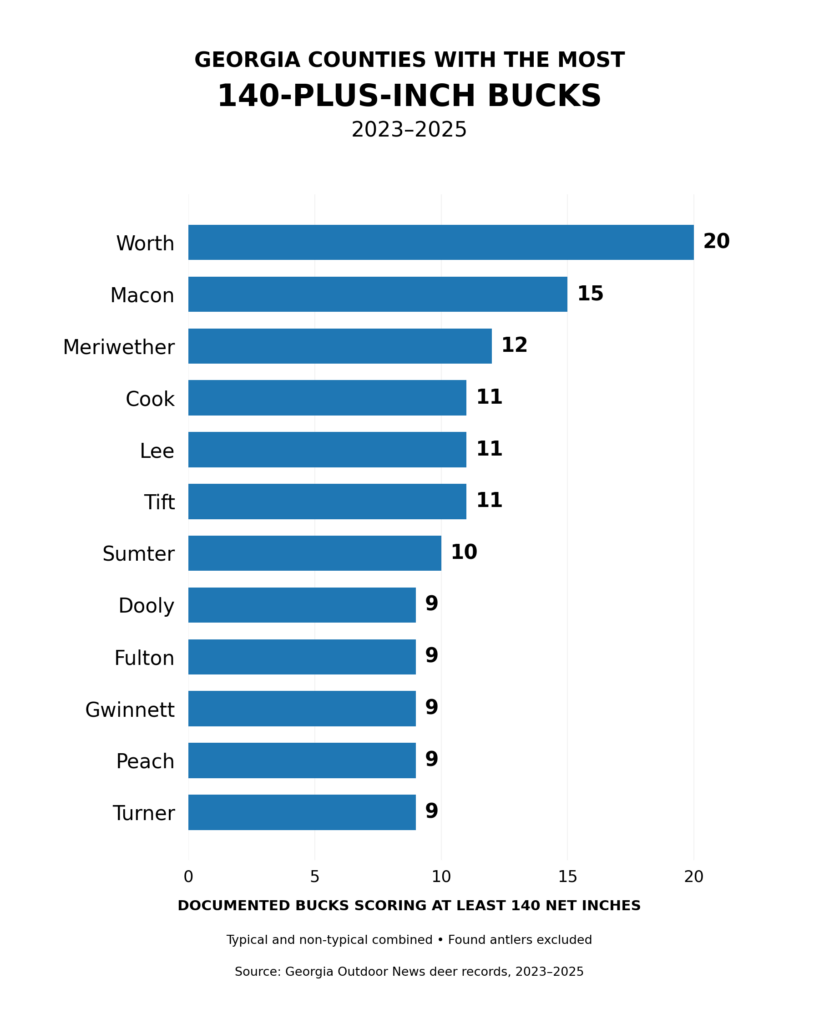
To find out where the biggest bucks are coming from, we dug into the Georgia Outdoor News (GON) deer records database and examined officially scored bucks harvested during the 2023, 2024, and 2025 calendar years.
For this comparison, we included all bucks with a net antler score of 140 inches or greater, regardless of whether they were typical or non-typical. We included bucks taken by all hunting methods but excluded found antlers.
And let’s face it, a 140-inch buck is a heck of a deer anywhere in Georgia!
Georgia’s Top Counties for 140+ Inch Bucks (2023–2025)
| County | 2023 | 2024 | 2025 | Total |
|---|---|---|---|---|
| Worth | 7 | 7 | 6 | 20 |
| Macon | 4 | 6 | 5 | 15 |
| Meriwether | 4 | 2 | 6 | 12 |
| Cook | 2 | 5 | 4 | 11 |
| Lee | 2 | 5 | 4 | 11 |
| Tift | 6 | 2 | 3 | 11 |
| Sumter | 3 | 5 | 2 | 10 |
| Dooly | 4 | 1 | 4 | 9 |
| Fulton | 3 | 3 | 3 | 9 |
| Gwinnett | 5 | 3 | 1 | 9 |
| Peach | 2 | 4 | 3 | 9 |
| Turner | 5 | 1 | 3 | 9 |
Source: Georgia Outdoor News deer records, 2023–2025. Includes typical and non-typical bucks with official net scores of at least 140 inches. Found antlers excluded. Counties tied at nine qualifying bucks are all included.
Worth County Leads the Pack
If there’s one county that stands out in the latest numbers, it’s Worth County.
Located in southwest Georgia, Worth County produced 20 documented bucks scoring 140 inches or better over the three-year period. Even more impressive is its consistency, with seven qualifying bucks in both 2023 and 2024, followed by six in 2025.
Macon County finished second with 15 qualifying bucks, while Meriwether County claimed third with 12.
Cook, Lee, and Tift counties tied for fourth with 11 bucks each.
One thing that immediately jumps out is the strong showing from southwest and south-central Georgia. Worth, Macon, Cook, Lee, Tift, Sumter, Dooly, Peach, and Turner counties all made the list.
It’s a region with a long history of producing impressive whitetails, and these latest records suggest that tradition is alive and well.
But don’t overlook other parts of the state.
Meriwether County, in west-central Georgia, finished third overall and tied Worth County for the most qualifying bucks in 2025, with six.
Even more interesting is the appearance of Fulton and Gwinnett counties among the leaders.
Both are heavily developed metro Atlanta counties where hunting access and regulations can present challenges. But where bucks have suitable habitat and manage to avoid hunting pressure long enough, some impressive antlers can result.
What These Big-Buck Rankings Really Tell Us
Across the three years, GON’s database contained 349 qualifying entries scoring at least 140 inches, excluding found antlers.
That’s a pretty impressive collection of Georgia whitetails!
However, there’s an important limitation to these rankings.
GON’s database includes bucks submitted for official scoring and entered into its records. It doesn’t include every 140-inch buck harvested in Georgia. Plenty of hunters kill exceptional deer that are never officially measured or submitted.
That means counties with more hunters participating in the scoring and record-submission process may have an advantage.
The rankings also don’t account for county size, available hunting acreage, or hunter participation. They’re a comparison of documented trophy buck production, not a measure of your odds of harvesting a 140-inch deer.
Still, when a county consistently produces big bucks year after year, it’s worth paying attention.
And while Worth County tops our latest list, don’t assume you need to hunt southwest Georgia to kill the buck of a lifetime. There are exceptional whitetails scattered across the state, including counties that didn’t make this list.
Sometimes the best big-buck county is simply the one where you have access to good habitat and enough patience to let a buck grow old.
Best Georgia Counties for Filling the Freezer
If you’re more interested in filling the freezer than making another trip to the taxidermist, we’ve got you covered there, too!
Fortunately for Georgia hunters, there are good deer-hunting opportunities across much of the state. But deer harvests vary considerably among counties.
To compare those opportunities, we examined the state’s 2025–2026 deer harvest records.
Rather than simply ranking counties by the total number of deer harvested, we looked at reported deer harvest per square mile of land.
Why?
Because counties vary greatly in size. A large county may have more deer harvested overall simply because it contains more land. Calculating harvest per square mile gives us a better basis for comparison, although it isn’t a direct measure of deer population density or an individual hunter’s odds of success.
Georgia Counties With the Highest Deer Harvest Per Square Mile
| County | 2025–2026 Reported Harvest | Deer Harvested/Sq. Mile |
|---|---|---|
| Hart | 1,970 | 8.5 |
| Gordon | 2,894 | 8.1 |
| Franklin | 2,035 | 7.8 |
| Banks | 1,731 | 7.4 |
| Madison | 2,078 | 7.4 |
| Hall | 2,874 | 7.3 |
| Warren | 2,034 | 7.2 |
| Hancock | 3,095 | 6.6 |
| Polk | 1,982 | 6.4 |
| Lincoln | 1,316 | 6.3 |
Source: Georgia DNR 2025–2026 Game Check harvest records. Harvest density calculated using U.S. Census Bureau county land-area measurements. Figures rounded to one decimal place.
Hart County leads the latest comparison, with approximately 8.5 deer reported harvested per square mile during the 2025–2026 season.
Gordon County isn’t far behind at 8.1 deer per square mile, followed by Franklin County at 7.8.
One interesting takeaway is the strong showing from northeast Georgia. Hart, Franklin, Banks, Madison, and Hall counties all make the list.
Meanwhile, Warren and Hancock counties continue to show strong harvest numbers in east-central Georgia.
In fact, Hancock County was the top-ranked county in our original analysis using 2022–2023 data. While it no longer holds that distinction, its 2025–2026 harvest of 3,095 deer demonstrates that it remains one of the state’s most productive counties in terms of reported harvest.
Keep in mind that these numbers don’t necessarily mean you’ll encounter eight deer for every square mile of ground you hunt. Harvest totals are influenced by hunter participation, accessibility, habitat, hunting regulations, and other factors.
Still, these counties are worth a closer look if you’re searching for a place to consistently put venison in the freezer.
Which Georgia Counties Harvest the Most Deer?
Harvest density is useful, but there’s another way to look at the numbers.
What if we ignore county size and simply examine where Georgia hunters reported the most deer harvested during the 2025–2026 season?
Here are the results.
| County | Total Reported Harvest |
|---|---|
| Burke | 3,322 |
| Washington | 3,230 |
| Laurens | 3,101 |
| Hancock | 3,095 |
| Floyd | 2,953 |
| Meriwether | 2,942 |
| Gordon | 2,894 |
| Hall | 2,874 |
| Wilkes | 2,775 |
| Cherokee | 2,506 |
Source: Georgia DNR, 2025–2026 Game Check county harvest records.
Burke County takes the top spot with 3,322 deer reported, followed by Washington County with 3,230 and Laurens County with 3,101.
Hancock County again makes an impressive showing, ranking fourth statewide in total reported harvest while also appearing among the leaders for harvest per square mile.
Gordon and Hall counties also appear on both lists.
These numbers help illustrate why looking at multiple measures is useful. Burke County led the state in total reported harvest, but its considerably larger land area means it doesn’t rank among the top counties for harvest per square mile.
Neither ranking guarantees success. But both offer useful insight when deciding which parts of Georgia deserve a little more attention.
10 Worst Georgia Counties for Deer Hunting
All right, here’s the part where I start getting hate mail.
Before anyone gets too worked up, let’s establish one thing: there really isn’t a county in Georgia where you can’t find good deer hunting somewhere.
However, some counties present more challenges than others, whether because of lower deer populations, limited hunting access, habitat conditions, or hunting restrictions.
To identify Georgia’s toughest counties for deer hunting, we examined two sets of data: Georgia DNR’s reported deer harvest per square mile during the 2025–2026 season and GON’s records of bucks scoring 140 inches or greater from 2023 through 2025.
We ranked counties by reported harvest per square mile, then added the number of documented 140-inch-plus bucks to provide another perspective on each county’s hunting potential.
We excluded Clayton, Cobb, DeKalb, and Fulton counties from consideration because their extensive urban development and special hunting restrictions make them difficult to compare fairly with predominantly rural counties.
Georgia’s 10 Worst Counties for Deer Hunting
| County | Bucks 140+ (2023–2025) | Deer Harvested/Sq. Mile (2025–2026) |
|---|---|---|
| Chatham | 0 | 0.6 |
| Glynn | 0 | 0.7 |
| Charlton | 0 | 0.8 |
| Camden | 0 | 1.0 |
| McIntosh | 0 | 1.0 |
| Rabun | 1 | 1.0 |
| Long | 0 | 1.0 |
| Clinch | 0 | 1.1 |
| Liberty | 0 | 1.2 |
| Echols | 0 | 1.2 |
Sources: Georgia DNR 2025–2026 Game Check harvest records, U.S. Census Bureau county land-area measurements, and Georgia Outdoor News deer records (2023–2025). Harvest figures are rounded to one decimal place. Big-buck totals include officially recorded typical and non-typical bucks scoring at least 140 net inches, excluding found antlers.
Southeast Georgia Dominates the List
One thing that immediately stands out is the concentration of counties in southeast Georgia.
Nine of the 10 counties on our list are located in the southeastern portion of the state, including several along the coast and around the Okefenokee Swamp.
Much of this region consists of extensive wetlands, pine flatwoods, coastal marshes, and large timber holdings. While these habitats certainly support deer, they don’t necessarily provide the same combination of food resources and productive deer habitat found in some of Georgia’s agricultural regions.
Hunting access also plays a role, particularly in coastal counties where urban development, waterways, and protected lands limit the acreage available to hunters.
Rabun County is the geographical exception. Located in the northeast Georgia mountains, Rabun features extensive public forestland and rugged terrain that can make deer hunting challenging.
What About Big Bucks?
Here’s where the numbers get particularly interesting.
Of the 10 counties with the lowest reported harvest density, nine had no bucks scoring 140 inches or better entered into GON’s records during the 2023–2025 period.
Rabun County was the only exception, with one qualifying buck.
That’s quite a contrast to Worth County, which led the state with 20 documented bucks scoring 140 inches or greater over those same three years.
But there’s an important distinction: having no entries in GON’s records doesn’t mean a county didn’t produce any 140-inch bucks. It simply means none were documented in the database for that period.
And before you write off southeast Georgia as a poor destination for trophy bucks, consider Seminole County.
Although Seminole has relatively low reported deer harvest density, it produced an incredible 196 7/8-inch non-typical buck taken by Collin Chandler with a bow in 2025. In fact, Seminole County had two qualifying bucks entered into GON’s records that year.
That’s a pretty good reminder that low harvest numbers don’t necessarily mean a county can’t produce an exceptional deer.
Don’t Let the Rankings Fool You
As with our lists of the best counties for big bucks and filling the freezer, these rankings have limitations.
Reported harvest per square mile isn’t a direct measurement of deer population density. The numbers are influenced by hunting pressure, access, habitat, regulations, and how many hunters report their harvests.
Likewise, the GON records represent only those bucks submitted for official scoring and entered into its database.
A county with low overall harvest density may still have pockets of excellent deer habitat and productive hunting properties.
So, if you hunt one of these counties and consistently see deer or take mature bucks, don’t let our rankings convince you otherwise.
Ultimately, the quality of the property you’re hunting, how it’s managed, and your willingness to put in the work matter a whole lot more than where your county falls on this list.
And if you kill a 160-inch buck in one of our worst counties, be sure to send us a picture!
While Georgia Afield works to keep this information accurate and current, hunting dates and regulations can change and may vary by county or property. Always consult the current Georgia hunting regulations and any applicable property-specific rules before heading afield.